

This fascinating recollection of cider making on a family farm in autumn days gone by was written by Henry A. Wise. Born in Accomack County in 1877 he grew up to become a schoolteacher and a school administrator. In his retirement years he turned his attention to history and culture of his native Eastern Shore, writing two books, Over on the Eastern Shore and Yesteryears on the Eastern Shore.
This is a short chapter from Yesteryears, which was published in 1968 when Mr. Wise was 91 years old. It begins with a couplet from an old song that everyone on Virginia’s shore must have known back then, but the internet seems to unable to help me identify it today.
Anyway, here goes with the chapter Mr. Wise wrote:
“I caught Ida sucking cider,
Sucking cider through a straw.”
If someone caught Ida sucking cider through a straw, Ida probably did not live on the Eastern Shore. If the writer of the old song had said he caught Ida sucking cider through a stem, he would have described Ida’s way of sucking cider on the Eastern Shore correctly. Pumpkin stems were larger than straws and reached just the right size when cider-making time came along.
Cider making was a very essential part of farm life and home life in “those long-ago days.” Otherwise where would the lady of the house get her vinegar for seasoning, pickling, making souse, and all the other things for which vinegar was needed? Knowing this, the farmer made his own cider and vinegar, first for his own use, then to sell to the country store, or to share with the neighbors ….
Apples were, of course, necessary and every farmer had his own apple orchard. … Fall apples were cider apples, so the fall of the year was cider-making time. Apples had to be ripe but not too ripe, just ripe enough to be juicy, for it was the juice that made the cider from which the vinegar came.
Cider-making time was a busy time, second only to hog-killing time. And it was also a “joy-making time” for the men on the farm-they knew they were all going to share the results of their labor. They were not thinking of making vinegar, they were only interested in making cider. …
Grandfather Jacob had a large apple orchard, and also a large peach orchard. At various times during the fruit season, he … would load a boat with apples and peaches and take them to Baltimore for market. … As a rule, only the early varieties were sold on the market, the late-ripening varieties being the best for cider and vinegar.
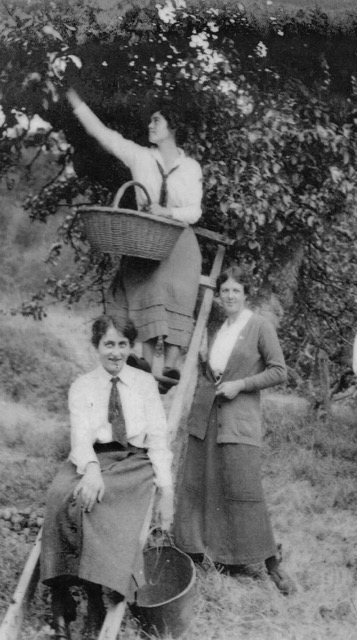 A little touch of frost on these and then it was cider-making time.
Gathering apples was not too much of a job. If the apples were bruised this did not matter. They had to be “beaten up” anyway, so they would be picked up, loaded into carts, then taken to the trough for beating.
The trough was [always referred to as] the “apple trough,” though it was only used during the cider-making season—a long trough and a deep trough—long so that six or eight men could be lined up on each side, and deep so that there would be room enough to handle the mauls, as the men used these mauls to beat the apples into pulp. (This present generation does not know what a “maul” is.)
… The apples were “pommeled” into pulp, and this pulp would be put under pressure to force out the juice. Pommeling apples was an art. Almost unconsciously that pommeling would get into rhythm; soon someone would start a song and those mauls would be going up and down in time with the song.
The only interruption would be when the leader would holler for “more apples,” which meant that pommeling was well under way, and soon the pulp would be ready for the press. The press was a wooden frame, set up on a platform, a trench cut in the platform to take the juice to a waiting bucket or to another trough. The press and the trough were usually placed under a tree to which one end of a lever would be fastened, just
over the press.
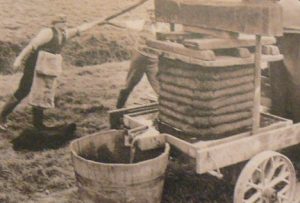
Working the Cider Press
When the men sang out that they were ready to press, the pulp was shoveled into the press, a cover that just fitted into the press put on, and now things were ready to run. The same men who did the pommeling got a hold on the lever, applied the necessary pressure, and someone who was on the lookout would call out “She’s a-running!”
Cider making was well under way. This just kept going until all apples had been beaten into pulp, the pulp pressed into juice, the juice, now cider, was put into hogsheads or vinegar barrels, to wait until this was a few days old, and was then enjoyed as a beverage, probably the aim of the men in the first place.
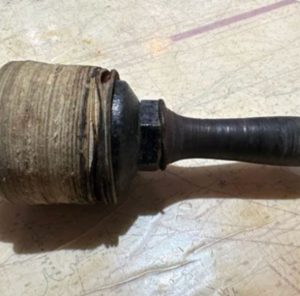
Vintage Wooden Maul Seen on Etsy
These barrels—there would be one, two, or three according to apple crop—would be stored in the barn, placed on a platform high enough to let a bucket or container of some kind be placed under the spigot that had been put in near the bottom of the barrel.
After standing for about four days, this cider would be “sweet cider;” in two to four weeks it would become “hard cider,” and this is just what the men around the place liked.
To make things easier for the housewife, several demijohns were filled and put aside in the storeroom or pantry, not that the housewife wanted cider for drinking purposes but because she wanted vinegar on hand when she wanted it.
And so the vinegar was made, enough for home use, some to give to friends, some to sell to the country stores or to city folk who had learned about country vinegar.
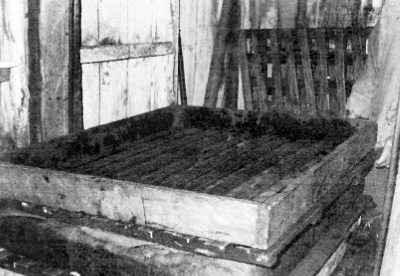
Rack Used in Cider Making
Sometimes, however, the vinegar stored did not measure out as it was supposed to measure out. The barn door was seldom, if ever locked, so it was very easy for the farm laborers to slip into the barn—apparently looking for a tool—perhaps get out a hidden
cup and turn on the spigot. That “hard cider” stage did not last too long, and one had to use the opportunity while it presented itself. Vinegar was not intended for drinking, but hard cider was.
Today ask any boy or girl where his or her mother gets her vinegar, … [and] they do not even know that vinegar comes from apples.
And that’s where the chapter ends. You can learn more about Mr. Wise’s book online here. It might be available for free download on the Internet Archive, but that site was down during the weekend I worked on this and I can’t be sure. I found my copy at a used book sale in an area library.
–posted by Jim Duffy for Whimbrel Creations LLC/Secrets of the Eastern Shore. Thank you very much for spending some time with this piece and on this site. Please feel free to comment on this piece if it stirred memories or otherwise sparked your interest. The comment window is just below here—keep scrolling.


