

PRELIMINARY NOTE: After learning about the astounding story of Matthew Roberts, I decided to try my hand at sketching out a movie concept. The style here is a little different from what I usually do. Let me know what you think in the comments!
Scene 1: Prologue, Miles River Neck
Aerial view of Chesapeake Bay and shoreline landscapes, camera eventually swinging onto Miles River Neck in Talbot County, Md. Thick forests. Lush farm fields. Meandering rivers. Stately waterfront homes.
The year is 1846. Zoom in on Wye House, the Lloyd estate. Show scenes and details that place this family among Maryland’s oldest and richest clans. Most of their 9,000 acres are right here on Miles River Neck, but they own plantations in Louisiana, Mississippi, and other far-flung locales as well.
The camera should linger in a fancy parlor or elegant hallway. One wall should be wall adorned with a series of rich-guy portraits. Pause over nameplates. The Lloyds have a weird attachment to the name Edward. The patriarch at this 1846 moment is Edward VI.
Head back outside. The Lloyd plantation is like something out of “Gone with the Wind.” Seven hundred slaves is a gigantic number for Maryland’s Eastern Shore. Show scenes of slavery. Laboring in farm fields. Toiling in shipyards. Hammering in blacksmith shops. Pause over an angry overseer, whip in hand. Slave-quarter cooks, sweating over a vat of stew. Wye House staff, creating culinary delicacies for the Lloyds’ table.
Pan through slave quarters full of one-room cabins. Children playing, happily. Here is five-year-old Matthew Roberts. Historians know nothing of his upbringing, so we’ll have to rely on educated guesswork. The evils of slavery probably haven’t touched his life yet. Show him as a precocious boy, full of enrgetic curiosity. Consider a bit of foreshadowing: Maybe Matthew is a little on the brash side. Show him pushing up against a boundary, challenging the authority of a parent or elder.
Scene 2: Should He Stay, or Should He Go?
Fast forward. It’s 1863. Matthew is 22 years old. Show a closeup of his eyes—they’re full of fear. Sweat trickling down a temple. Camera pulls back. He’s hiding behind a tree, brimmed hat pulled low.
What we know from oral history: Matthew is in trouble. What did he do wrong? We don’t know. What we know is that an overseer is planning to whip Matthew and that this turn of events is a straw-that-broke-the-camel’s-back moment for him. He’s determined to run away.
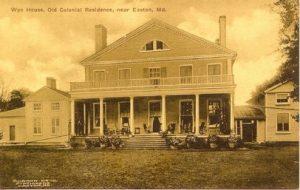
The Wye House on Miles River Neck
We’ll need to flesh this out in the movie. Maybe we could have him meet up in that wooded hiding place with a trusted loved one. A brother, perhaps? Hushed, urgent whispers. Matthew explains the situation. Maybe he claims innocence.
Has Matthew been whipped before? Probably. The historical record contains a good number of hints that Edward VI was not a benevolent slave owner. There are accusations in there that he was so cheap he shorted slaves on food and clothing. And that discipline was harsh–whippings, beatings. Supposedly, Edward VI liked to use his Deep South properties as threats, telling “misbehaving” slaves he was going to ship them far away from families and loved ones.
Matthew tells his “brother” he’s done with all that. He’s gonna run.
Does his “brother” argue? Maybe he should. He could point out that Matthew doesn’t have much of a plan. As far as we know Matthew had no connections with the Underground Railroad. He had no one he’ll be able turn to for help while on the lam. Has Matthew ever set foot off of Miles River Neck? It’s possible. Some Wye Plantation slaves got assigned to mariner duty on boats traveling the Chesapeake. But most remained close to home. Maybe a rare trip into Easton or St. Michaels?
Educated guess: Matthew doesn’t have a clue beyond the general direction of north about the location of this “Pennsylvania” place that lets blacks live in freedom. Maybe the “brother” urges him to stick around, do some planning, make connections with that Underground Railroad.
Matthew doesn’t listen. Logic be damned: “No more whippings!”
Scene 3 (action): The Runaway
Off he goes! Camera follows, as he sprints through woods. Swoosh of leaves brushing shoulders. Crack of twigs underfoot. Hard breathing. Maybe that hat falls off his head. He stops, stoops, picks it back up.
Already, trouble is on his trail. White men, on horseback. Matthew keeps to the thickest bit of forest and brush. Horses won’t be able to maneuver there. Still, the noise is not far off—are they getting closer?
Matthew comes to a creek. It’s not really a creek. Here on Maryland’s Eastern Shore, that word is often given to broad, deep waterways that would qualify as rivers everywhere else. Was it Leeds Creek? Hunting Creek? Some other creek? We don’t know. But it’s a big piece of water.
Matthew pauses. Closeup. His breath slowing. His thoughts jumbled. And then … isn’t it amazing when people in death-defying moments come up with an idea that’s kind of brilliant? Let’s watch that thought take shape through Matthew’s facial expressions.
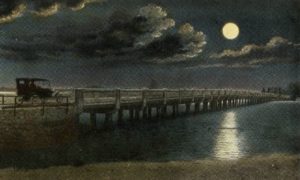
Postcard depicting a later version (1929) of the Miles River Bridge
He’s not going to cross that creek. But he’s not going to keep running on this side either. He takes off his hat and throws it as far as he can out into that water. Then Matthew looks around. Finds a thicket of grape vines. He crawls into that hiding spot.
Now the camera shows horses rushing along a trail. Loud, urgent voices. Men pulling up to that creek. What’s that in the water? His hat?
They pause. The voices are confused. What does this hat in the creek mean? Did Matthew try to cross? Can you hear bits of possible conversation?
“Anyone know if that ‘boy’ can swim?”
The white men debate. Maybe Matthew made it to the other side. Or maybe he didn’t. He could have lost that hat when it got too deep for him, then retreated back to this side. Or maybe he’s dead, drowned. The white men agree to start there. Kicking horses into action, they start looking around for Matthew’s body.
The camera should watch what happens from Matthew’s perspective, from down under those grapevines. Men and the horses moving slowly away, voices fading. Finally, they’re out of sight. Matthew is up and running again. Swoosh of leaves brushing shoulders. Crack of twigs underfoot. Hard breathing.
Is his adrenalin still pumping? Or is he getting tired?
Another waterway. This time, the Miles River. Unlike that creek, the Miles has a bridge over it. It’s a privately built toll bridge, erected just a few years before. If Matthew can get across, he’ll be off of Miles River Neck. It’s not freedom in the north, not even close. But hey, one step closer to that mysterious free place called “Pennsylvania.”
He makes for the bridge. Clearing the woods, he moves through an open field. Then his eyes go wide. There, on the river, belches of smoke rising. A steamboat! Steamers at this time were mostly wooden vessels with low, lean profiles. It’s heading toward the bridge.

A steamboat from about the 1860s
Blind luck? Divine intervention? Who cares?
Does Matthew have coins in his pocket to pay the toll? If so, he’ll have to fake like he’s calm, cool, and collected. Or does he just sprint right past the gatekeeper without paying, like a modern turnstile jumper. Can you hear that gatekeeper’s screams of outrage?
Matthew is out on the bridge. Smoke plumes, drifting closer. He works out the timing in his head. He waits. He waits more. He crouches. He jumps. He flies!
Thunk!
What happened when he landed? Historians have no idea, and the oral history doesn’t say. Maybe he miraculously ended up in a spot where no one saw him? Maybe the crew of the steamer had free black mariners, willing to help? Maybe this vessel was captained by a sympathetic white man? We’ll have to choose one of those options for the movie.
Bottom line: Matthew is sailing north. Toward freedom. At long last he takes some easy breaths.
Perhaps the camera could alternate between the astonished expression on his face and the scenery en route. The boat steams out of the Miles River. Into Eastern Bay. Around Kent Island. Up the Chesapeake Bay. Big left turn into the Patapsco River. And then, the bustling Inner Harbor of the nation’s fourth largest city. Hello, Baltimore.
Scene 4 (set up): The Big City
Camera shows Matthew, a mix of happy and confused and cautious, making his way along the streets of a big city for the first time. He’s still in Maryland. Slavery is legal. But: Things are different in Baltimore. 30,000 black folks, and 90 percent of them legally free. Matthew can slip into the shadows here and get by. Maybe he’ll find a new life and stay forever. Or maybe he’ll only stay long enough to scrounge up some money and move on.
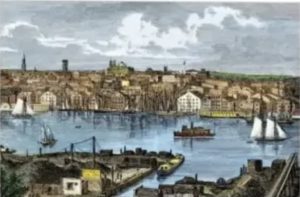
Postcard depicting Baltimore’s Inner Harbor in the 1870s
We don’t know any details about his time in Baltimore. The movie could show Matthew having trouble getting by. With the Civil War raging, Baltimore’s economy is in the tank—“paralyzed,” in the words of one historian. Maybe Matthew ends up broke and hungry. Or maybe he does all right, finding odd jobs and kindly souls and plenty to eat.
Either way, the important part of this big-city chapter comes in a moment when opportunity knocks. Maybe Matthew heard about that opportunity through the free-black grapevine. Maybe he saw one of the fliers posted around town. Did he know how to read? Probably not. Maybe some free black man read that flier to him. Or maybe he heard some guy up on a street corner soapbox—there was a lot of that going on back then.
Whatever: On Sept. 1, 1863, Matthew enlists in the U.S. Colored Troops.
We’ll never know why. Did he sign up out of desperation, trying to get three square meals a day? Or was he determined fight like hell for the freedom of enslaved people, like his family and friends back on Miles River Neck? Maybe both? Bonus: They’re promising that when his army days are over, he’ll be a free man. Good riddance to Edward Lloyd VI.
Have the camera shows Company K of the 4th Regiment. It’s early days. They’re gathering at Camp Birney. Do you know Baltimore? It’s near where Druid Hill Park is nowadays. Camera shows Private Matthew Roberts, resplendent in a brand new, impeccably pressed uniform. Eventually, he and his new compatriots get on boat bound for Tidewater Virginia.
It’s October. The hard part begins. Have the camera show the 4th Regiment training at Yorktown. Matthew among them, sweat-drenched and gasping through the exercises. White commanding officers, barking orders. Do they maybe sound a little too much like Matthew’s old overseer?
But they get the 4th Regiment ready. The camera follows as they march out of Yorktown, headed for war, fighting for freedom.
Scene 5 (action): The Battlefield
Show scenes of battle, one after another. The 4th Regiment saw lots of action over the next two years. Some in North Carolina, some in Virginia. They were one small part–like a spoke in a bicycle wheel–of the complex plan General Ulysses S. Grant devised to try and bring down the Confederate capital of Richmond.
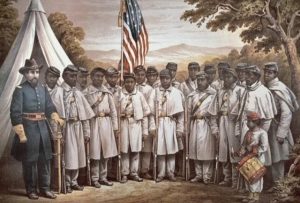 Some of the fights the 4th gets sent into are brutal and deadly affairs. Civil War buffs will recognize battle names: Petersburg, City Point, Chapin’s Farm, Dutch Gap, Spring Hill, Jordan’s Farm, and Bermuda Hundred.
Bottom line: One out of every three of the men in the 4th won’t make it home.
Matthew shouldn’t have made it home. He escaped that fate only by a miracle. That scene unfolds in the aftermath of a brutal battle. Historians don’t know which battle. Oral history doesn’t say. Have the camera pan a field littered with bodies. So many dead. Some wounded and in agony. Matthew is “crippled in the leg,” unable to move.
Enemy Confederate soldiers approach. As they meandering through the Union dead, they commence stealing from Union corpses anything they might need or want–weapons, shoes, money, whatever. Inhuman things happen in wartime, and such a moment is about to unfold. Some Confederate soldiers commence murdering wounded men in Union uniforms. This was not commonplace on Civil War battlefields, but it happened a few times. And when it did, the victims were mostly likely to be U.S. Colored Troops.
The rebels banter back and forth out on that field. Perhaps they’re laughing amid the horror. Wounded Union soldiers start begging for their lives. Matthew starts begging for his life. The camera zeroes in on one Confederate soldier. He’s got a different look, like he’s on an urgent mission. He’s got no time for thieving and murdering. Somehow, he’s figured out that the 4th Regiment is from Maryland. So is he. His name is Lewis Trail. He keeps asking:
“Anybody from the Eastern Shore?”
And that leads him to Matthew Roberts. Lewis Trail has a problem. He needs to get a message to his family back home, but that’s not easy for a Confederate soldier in wartime. Historians don’t know what the message is. Oral history doesn’t say. Maybe it was urgent family news—a wounded or dead sibling. Maybe it was just: “I’m alive. I’m ok. I love you.” We’ll have to pick one to use in the movie.
The camera should show Lewis Trail kneeling over Matthew Roberts and inspecting that wounded leg in businesslike fashion. Trail smiles. Everything looks perfect in his eyes. That leg is hurt too bad. The doctors will never let this soldier back on a battlefield. They’re going to have to discharge him, send him home.
Trail cuts a deal with Matthew. He won’t let his Confederate compatriots kill him. He’ll take Matthew back toward the Union lines. But only if Matthew agrees to deliver that message to his family.
Matthew couldn’t very well say no, could he?
Scene 6: The Bittersweet End
Camera pans over Fort McHenry. Baltimore, May 11, 1866.
 There is Matthew Roberts, still in uniform. Standing in line. Limping badly as the line moves. Perhaps he talks with a comrade along the way about what he’s been through. After surviving on that battlefield, he’d been shipped to Fort Monroe, Va. After that, the army shipped him to Baltimore and put him in Hicks General Hospital on West Baltimore Street. Doctors there wanted to amputate his injured leg. Matthew wouldn’t let them. That’s what the oral history says, anyway.
The line at Fort McHenry comes to an end. The camera shows Matthew, collecting his discharge papers. How big is the smile on his face? Or is he grimacing instead, from too much pain in that leg?
Fast forward. Days? Weeks? Months? We don’t know how long it takes, but Matthew ends up back on his home turf of Talbot County. His military records say that he told the Army to send the money they owed him to the post office at Easton.
So let’s show him in Easton, then, picking up a check. We don’t know for sure whether he followed through on the battlefield deal he cut with Lewis Trail. But he probably did, don’t you think? So maybe let’s have the movie show him meeting up with the Trail family and relaying that message. Perhaps they are relieved to hear that mysterious message. Or was it bad news and they are pained?
It’s a small world. Lewis Trail is related to the Lloyd family. Remember mean old Edward VI? Yeah, that family.
The end of the movie is all guesswork, because historians don’t know a lot about what became of Matthew Roberts in freedom. Here’s one no-brainer scene: Show Matthew back on Miles River Neck, reuniting with loved ones. Perhaps Matthew is regaling them amid much raucous laughter with the tale of his big miraculous leap to freedom from the Miles River Bridge. If you want the movie to go heavy on the shmaltz, we could have one of those loved ones make a gift to him of the tattered old hat he threw into the creek.
Another moment of joy, this one based in documented fact. Matthew signs off on a mortgage agreement. He’s going to move into a house in a community built by U.S. Colored Troop veterans in partnership with a sympathetic Quaker landowner named Ezekiel Cowgill. That town—Unionville—is a whole other historic story, worth a movie all its own.
But alas, the ending can’t be all happy days and rainbow stew. There’s going to be some pain and agony, too, if we’re going to stay true to Matthew’s story. Oral history on Miles River Neck says that the doctors at Hicks General were right to want to amputate Matthew’s leg. The wound never healed properly. Mattew died “several years later” from complications, presumably an infection. Military records say Matthew received his last round of Army pay on Jan. 20, 1867, so he made it that long.
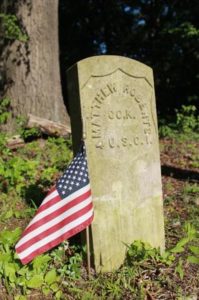
Perhaps the movie should end with Matthew’s funeral. We don’t know have a date, but we have a place. Matthew’s undated gravestone is still standing tall today on Miles River Neck, at St. Stephens Church in Unionville. He is one of 12 USCT vets resting in that cemetery.
Maybe pull some Hollywood trickery as the credits roll, morphing from Matthew’s funeral, with friends and family weeping, into a somber modern-day scene in the same spot. Respectful crowd gathers on Memorial Day. Preacher marvels over the sacrifices men like Matthew made in their time. Maybe a little singing. Maybe a young boy in the audience, watching and listening.
Hey, does that hat he’s wearing look a little familiar?
And that’s the end.
–written and posted in August 2025 by Jim Duffy for Whimbrel Creations/Secrets of the Eastern Shore. All rights reserved.
AFTERNOTES:
- I hope that I was clear about what we know and what we’re guessing and what we don’t know. The story of Matthew’s escape (hat in the creek, jumping on a steamboat) and the story of his battlefield deal with Lewis Trail come from oral history. That history matches up with the thin collection of historical records. Those records show he was in Baltimore when the oral history says, that he enlisted like the oral history says, that he was injured and then discharged like the oral history says, and that he came back home like the oral history says.
- A few ideas for an itinerary for a Matthew Roberts daytrip. Take Md. Route 322 out of Easton, then turn north on Unionville Road. The bridge you will soon cross is the modern-day version (in a slightly different location) of the low-slung toll bridge that Roberts jumped off of, onto a passing steamboat. Visit Roberts’s grave in the cemetery at St. Stephens UMC Church, 9467 Unionville Rd. There are historic markers there and nearby with some information about Unionville. Wander the gorgeous winding roads of Miles River Neck, peering down long lanes toward old plantation houses and finding other historic black settlements, like Tunis Mills and Copperville. If you want to walk on land once owned by Edward Lloyd VI and perhaps walked on by Matthew Roberts, find your way to the Pickering Creek Audubon Center. The trails there are lovely and well-maintained.
- Lewis Trail died in 1923 at the ripe old age of 80. His name pops up now and again in old newspapers. He was a successful farmer. One article refers to him as “one of richest men in Talbot County.” He attended Confederate reunions. He served as pall bearer at funerals of fellow Confederate veterans.
- A bit of unresolved confusion: Oral history says Lewis Trail needed to get a message to “his father,” but the genealogical site Wikitree says his mother and father were both dead before the Civil War began. That’s why this story says he needed to get a message to his “family.”
- I tell the story of the founding Unionville in one of my books, Eastern Shore Road Trips #1: 27 One-Day Adventures on Delmarva. That book serves up modern-day road-tripping itineraries that are chock full of historical tidbits. Here is where you can find info on all of my books.
- Please do leave a comment if you’re so inclined. Constructive criticism always welcome! Either way, thanks for reading …


Love the story of Matthew Roberts and it would make a fabulous movie! I grew up in Delaware & on the Eastern Shore, Cecil County. I wish I had learned more of the history growing up. Thank you for your talented works!
Matthew Roberts is my Great Grandfather (6th). Your facts are on point! I love the story line. I actually have thought about making it a movie myself. I live on the eastern shore of Maryland and have visited Miles river neck area and Unionville a thousand times. I love the history. I’ve also gained a lot of my information from the Joseph Sutton Book “Praise the Bridge that Carries You Over” As well as the Frederick Douglass book. I’ve gained a lot of insight on their daily life and real events that took place. This just made me want to pursue my movie even more!!!
I’m so glad you found your way to this story, Nakia Brown–thank you for your kind words and best of luck with the movie :-)