

A deep freeze descended on the Chesapeake Bay early in 1926. Then that ice melted, and the big floes rode the waves, causing all kinds of havoc in the area of the Chesapeake Bay around Hooper Straits.
Wilmington Evening Journal headline:
ICE STORM WRECKS BIG OYSTER PLANTS
The story is datelined Wingate, Md., which is in the lower southern reaches of Dorchester County.
Property loss and damage in this section from the sudden and disastrous break-up of the recent freeze were sustained at the oyster-shucking and packing establishments of the Hooper & Parks Company and Asbury Wingate, both of the Honga River and Hooper Straits oyster district near here.
The entire plant of Asbury Wingate was swept from its piling pier in Fox Creek Cove on the mainland side of the Honga River and carried out into the channel, where the main building now rests on the bottom, its roof showing just above the water. … The larger establishment of the Hooper & Parks Company survived the assault of the ice in a manner, although the damage has been considerable.”
Similar damage to shucking and packing plants and to dredging and tonging boats left anchored in unprotected spots has been more of less general throughout the Fishing Bay, Nanticoke River, Honga River, and upper Tangier Sound sections, which are among the most productive of [Maryland’s] shellfish territory.
The Lowly Muskrat Saves the Day
But the story ends on a positive note–thank God for the muskrat and its role in keeping ladies of the 1920s warm and cozy through the winter months.
The ice movement has completely disrupted oyster taking and shipping. … This would cripple some districts where the shellfish industry is the sole commercial activity in winter season. The lower Dorchester and eastern Wicomico sections … are more fortunate … in that this is the ratting season. Muskrats are being caught in great numbers and a ready and brisk market for the furs is being found.
Ever since the Hudson seal–and this is the muskrat fur–gained widespread popularity as a material for milady’s winter coats, [this area] has profited to a degree unknown to many [other] districts on the Eastern Shore. … This is particularly fortunate on occasions such as the present.
A Deep Dive into the Muskrat-to-‘Seal’ Transformation

Actress Elisabeth Risdon in a Hudson Seal Coat
If you are curious about that reference to the “Hudson seal,” well, that was a bit of marketing genius from the early 20th century. That was a name given to muskrat fur that had been plucked and dyed in a special way that made it look like seal fur.
The Collins dictionary helpfully defines the term “Hudson seal” as “muskrat fur that has been plucked and dyed to give the appearance of seal.” The word entered the English language sometime between 1915 and 1920.
Here is Wikipedia:
In the early 20th century, the trapping of the [muskrat] for its fur became an important industry. During that era, the fur was specially trimmed and dyed to be sold widely in the US as “Hudson seal” fur.
A California newspaper, the San Pedro News Pilot, ran a big article about this in 1935. The writing approach was kinda hush-hush, with no company names and many details omitted to protect trade secrets. Still, there is a ton of information in the article.
Headline:
Skilled Furrier Transforms The LOWLY MUSKRAT into the Aristocratic HUDSON SEAL
Subhed:
Through the Use of Chemicals and Dyes, Expert Hands Turn Unattractive Little Rodents by the Thousands Into the Softest, Blackest and Most Supple Furs
‘Like a Piece of Velvet’
These converted skins were so soft, so supple, that they could be used like a piece of velvet, and there they had been made up into a slim, swanky coat with the dressmaker touch that they’re mad about in the Big City. All made of this Hudson seal, as they call the converted muskrats.
‘Kicking’ the Muskrat Skins
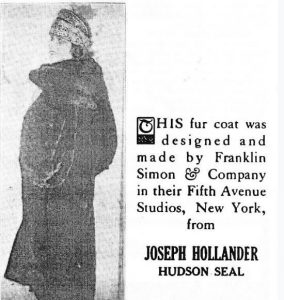
The process begins when hundreds of the muskrat skins are motored up to the door of the factory. They’re piled into big bins in the receiving room. The skins are inside out, and, after being stamped, the hide is treated with a chemical, the formula of course being secret.
This chemical greatly benefits the leather and tends to soften it, although at this phase it has about the consistency of tough cardboard. What do you suppose they do to contiue the softening process? They’re “kicked.” Very’ thoroughly kicked, too—for from 7 to 8 days. The “kickers” are really machines. Each machine has two beams, or legs, seven or eight feet long, fastened together at the top, and, at the “kicking” end they’re finished off with two big aluminum feet. These feet rest in a curved sort of bin, which, when in operation, is filled with the muskrat skins. When the machine is started, away they go—right, left—right, left—right, left. For all the world like a robot football team at practice. The kicks seem pretty well directed, too, for when the skins are through with this operation the cardboard-like qualities have been utterly routed. The skins are now as soft as chamois. …
‘Drumming’ the Muskrat Skins
They also visit a trimming department, where any little straggly ends are nicely rounded off so that they have a more even outline. Now the dressing of the skins begins in earnest. They arc brought in piles to a long row of immense “drums” nearly seven feet in diameter. There is an opening in each drum through which the skins are dropped into a supply of sawdust, previously treated with their own compounds. When these big drums begin to operate, the skins are rotated around and around in this sawdust, until they are saturated with it. And no sooner do they get saturated with it than it has to he taken out again, in big machines called “cages.” But with it come the impurities and foreign matter which may be present. One trip to the drums and cages leaves the skins fairly clean.
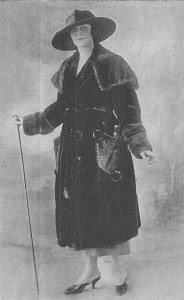
Wikimedia Commons says that this Hudson Seal coat was trimmed with mink.
“Fairly clean” doesn’t , mean a thing in this process, though—for the next I thing they do is comb out every solitary skin with a fine steel comb and brush, by hand. Out comes any little lurking tangle in the fur or any bit of stray sawdust. Now their real beauty treatment begins. They are plucked, sheared, unhaired, dyed, dried with dry steam, fleshed. Every operation is done by highly skilled, highly paid workmen. Any skin which developes an imperfection is discarded.
‘Shearing’ the Muskrat Skins
Each operation seems more interesting than the last. Shearing, for instance. First, girls sew the skins loosely together into a long strip which is then laid flat on a wide belt which runs under the knives of the shearing machine, each skin being fed separately to the knives, guided by the hand of the workman. The machines run at great speed and the knives are razor-sharp. They are run through again and again until almost all of the long hair down the back of the muskrat has been sheared off, and the skin has a lovely plush-like surface—although it’s still in what is known as the “white stage.”
‘Paddling’ the Muskrat Skins
There are two dyeing operations—one for the ground dye—the other a dye which gives the mirror-like sheen to the top of the fur. The ground dye is “paddled” on. That is—great vats stand in a row, filled with the blackets dye you can imagine. The “paddles” are something in the shape of huge old-fashioned water wheels. The power is turned on and the paddles rotate and paddle the skins around and around in the dye. When they are thoroughly black the skins are removed from the dye and wrung out.
But that’s not all. No less than six times this is done. When a skin is dyed by these furriers it stays dyed. The “top dye” is put on by a machine through which the skins are fed by hand over a big belt. They’re run through again and again until the operator considers the top gloss perfect. When they come out of this operation they are really lovely black silky “sealskins” to you.
‘Fleshing’ the Muskrat Skins
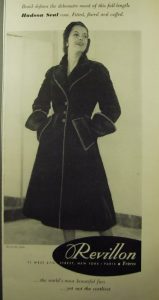
One of the biggest moments, though, comes next to the last. The skins are “fleshed.” The operator has, attached upright to a dong table, what looks like a big compass, only the wheel part is a razor-sharp knife about a foot in diameter. Every skin is held one by one by an operator against these knives in such a skillful way as to even up the hide and thin it out to a certain point where it’s thin and supple enough to present debutantes with the slim silhouettes they demand of their fur coats.
Now they’re taken to another long table, along which at intervals there are “blowers”—the same general system as on our vacuum cleaners. The skins are held against this current of air, and every tiny hair is blown out fluffy and silky and beautiful. Then they’re piled leather to leather and away they go to be made into Hudson seal coats.
The story concludes:
And thereby hangs the tale of little muskrats.
–posted by Jim Duffy for Whimbrel Creations LLC/Secrets of the Eastern Shore in December 2024. Thank you so much for spending some time on this site!
AFTERNOTE #1: The icy photo up top here is a little off, timing wise. It shows the tugboat E. Clay Timanus heading out toward Chesapeake Bay during a deep freeze in 1936. The photo is in the collection of the Chesapeake Bay Maritime Museum.


