
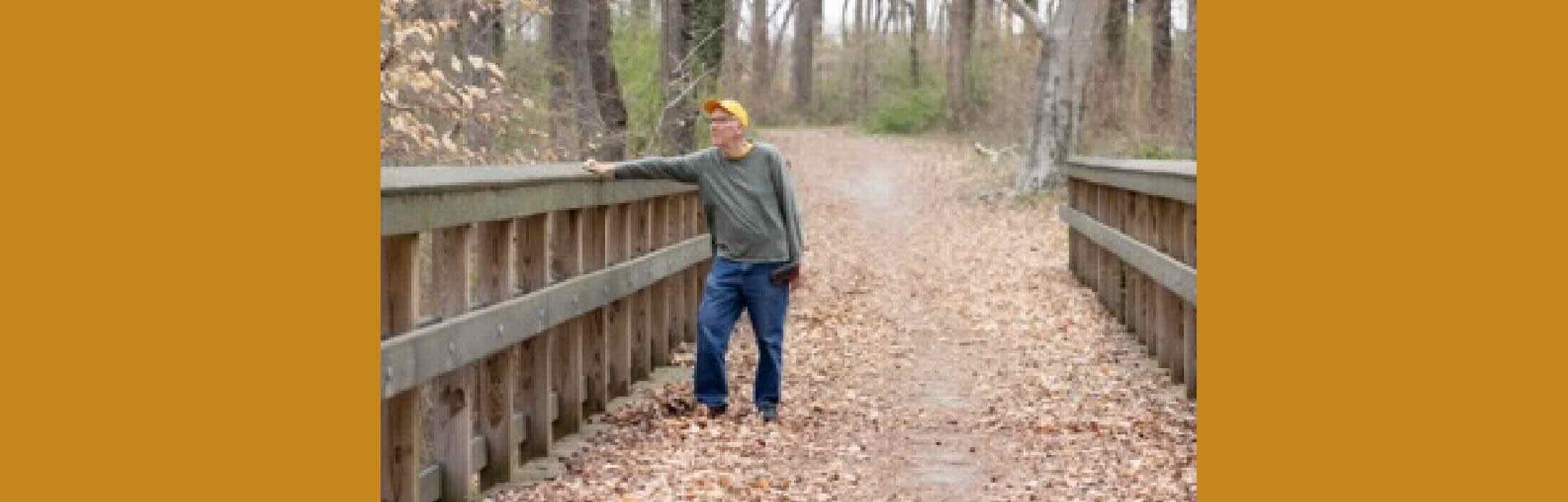
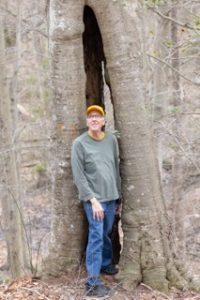
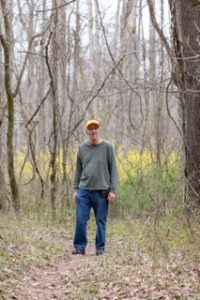
As the first hints of spring arrived in 2025, my wife Jill and I made a run up to Caroline County, Md. and set out for a hike along the Cliffside Trail in Tuckahoe State Park. That’s where the photos here are from. My yoga teacher Heather Rupp is an obsessive Tuckahoe hiking devotee–she’s the one who suggested this particular trail. It did not disappoint–pretty creek overlooks, bits of challenging elevation, and sweet springtime sightings of vibrant forsythia. Afterward, we headed into nearby Denton for lunch, followed by stops at that town’s little Museum of Rural Life and the Fiber Arts Center of the Eastern Shore.
Below is what I write about Tuckahoe in the book Eastern Shore Road Trips #1: 27 One-Day Adventures on Delmarva. It’s in a chapter titled “Going Green in Caroline,” and there’s lots more in that chapter’s itinerary–Adkins Arboretum, Martinak State Park, and the Pelot Bird Sanctuary, along with a run through of options for things to see and do in nearby Denton.
One of my favorite reviews of my Road Trips books totals five short words. It came across it on social media, from a satisfied reader named Samuel Baxter Magee: “Read it. Traveled. Loved it.” Here is where you can buy the books.
And here goes with the excerpt about Tuckahoe:
“A few years back I read the book Wilderness and the American Mind by Roderick Frazier Nash. One of the many things it taught me was that the idea of setting aside wild and open spaces is not really a modern notion at all. It’s a concept that has been waxing and waning in the Western World for quite a few centuries now.
“It was definitely waxing in Caroline County during the 1960s and 1970s, which is why this part of the Upper Eastern Shore ranks today as such a swell destination for folks who love hiking along winding paths through the woods and paddling along calm and isolated stretches of streams.
“Back in the early 1960s, one big idea that was popular among state officials was to build a version of Deep Creek Lake on the Eastern Shore. That project, located in the mountains of Western Maryland, covers 4,000 acres. The Eastern Shore version was going to be smaller, but the concept was the same—a man-made lake with miles of winding shoreline that would draw scads of recreational tourists.
“This is why the state first started buying up the land along the Tuckahoe River near the small town of Ridgely. But the Tuckahoe Valley soon delivered a bit of natural push-back: State engineers had their eye on a geological phenomenon known as “seepage” to keep the lake forever filled with water, but the seepage levels in the valley turned out to be lower than the engineers had anticipated.
 “Then surveyors working on plans for the lake stumbled upon a tree for the ages, an ancient overcup oak that stood 130 feet tall and had a gargantuan trunk nearly 23 feet around. The biggest member of its species in the whole country, it was soon declared a National Champion.
“That was the proverbial straw that broke the back of the lake project. But the state still owned a good amount of land, and what we ended up with instead is sweet as can be. Tuckahoe State Park covers some 4,000 acres of woodlands and streams and offers 25 miles of hiking trails. Fishing and paddling are big here, too—not just along Tuckahoe Creek, which gives the park its name, but also on the smaller man-made lake that the state eventually did build here. It clocks in at 60 acres.
“Back in the 1970s and 1980s, the park featured an over- look where visitors could admire the champion overcup oak that had helped to defeat the best-laid plans of all those state bureaucrats and engineers. Alas, the tree died in the 1990s. But the Tuckahoe Valley remains a very interesting place even in the absence of its champion. Both valley and creek take their name from the Indian word for arrow arum, a plant that produces an edible, potato-like root. A good number of Native American artifacts have been found hereabouts.
“Famed abolitionist Frederick Douglass was born into slavery in a cabin on this creek, a few miles below the park, on what is now private property. He escaped to freedom, of course, and soon began giving speeches and writing books and articles that turned him into a world-renowned champion of freedom.
 “In his later years, Douglass returned to the banks of the Tuckahoe and tromped around the land, trying to get back in touch with his roots. ‘I am an Eastern Shoreman, with all that name implies,’ he once wrote. ‘Eastern Shore corn and Eastern Shore pork gave me my muscle. I love Maryland and the Eastern Shore!’
“Some historians believe that Tuckahoe Creek was among the escape routes used by Harriet Tubman and other conductors on the Underground Railroad. The land along its shores was too marshy for farming, so it was one of the rare places on the Eastern Shore at that time that had a significant amount of tree cover along its banks, a very attractive feature for folks who wanted to stay out of sight while trying to make their way up into Delaware—and beyond, to freedom.”
There you have it. FYI, Tuckahoe State Park boasts an array of facilities in addition to hiking trails—cabins, campgrounds, playgrounds, mountain-bike paths, kayak rentals, and picnic pavilions among them. Here, again, is where you can buy one or both of my Eastern Shore Road Trips books.
Here is the Caroline County Tourism website.
–updated by Jim Duffy in April 2026 for Secrets of the Eastern Shore/Whimbrel Creations LLC. All rights reserved. Thanks so much for spending some time on this site!


